2017
intelligence
WSB establishes a separated market intelligence division to supply data services to charterers.
WSB keeps you up to date with latest news in the offshore market.


The best intelligence platform of the segment.
On the homepage, you'll find real-time data on currency exchange rates, live updates of weather conditions in key exploration basins, and the latest news published by WSB Advisors. It also features summaries of the most recent circularizations, along with the latest market updates provided by our commercial team.
WSB.One Dashboard →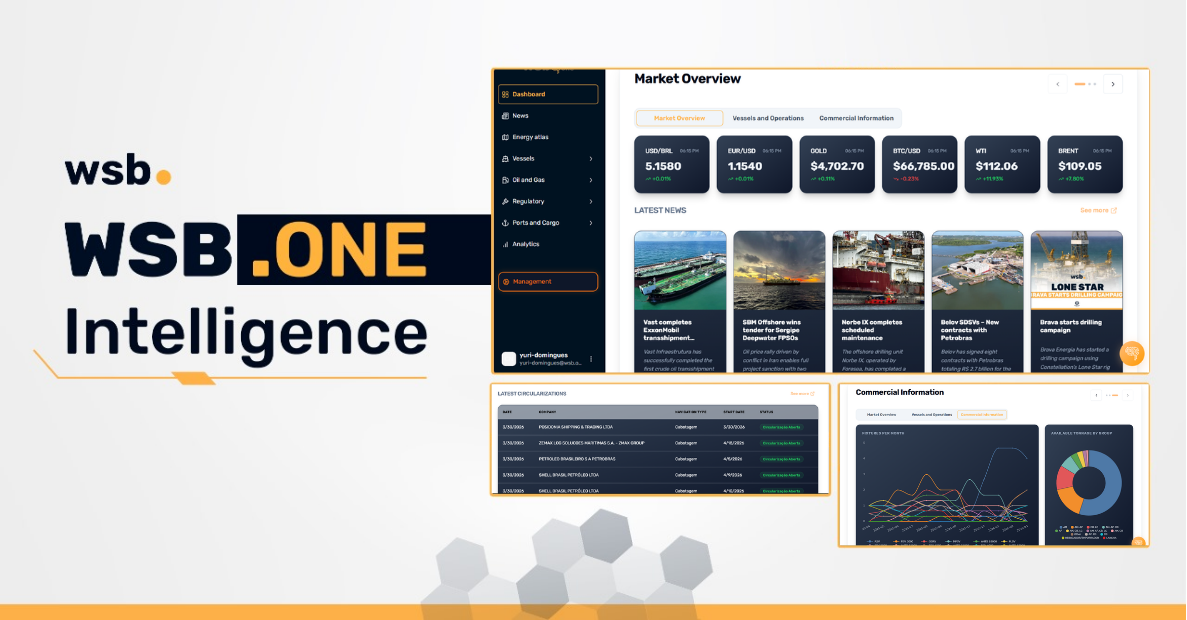
In the Positions tab, the user can instantly assess current status of each offshore supply vessel registered within the platform, whether they are Prompt, In Service, In Maintenance, Mobilizing or in Layup. With a vast range of filters to customize your search, it allows the user to navigate through every vessel type as well as numerous technical specifications such as deadweight, bollard pull, power output, above-and-below deck capacities, propulsion type, among many others.
WSB-One Vessels Positions →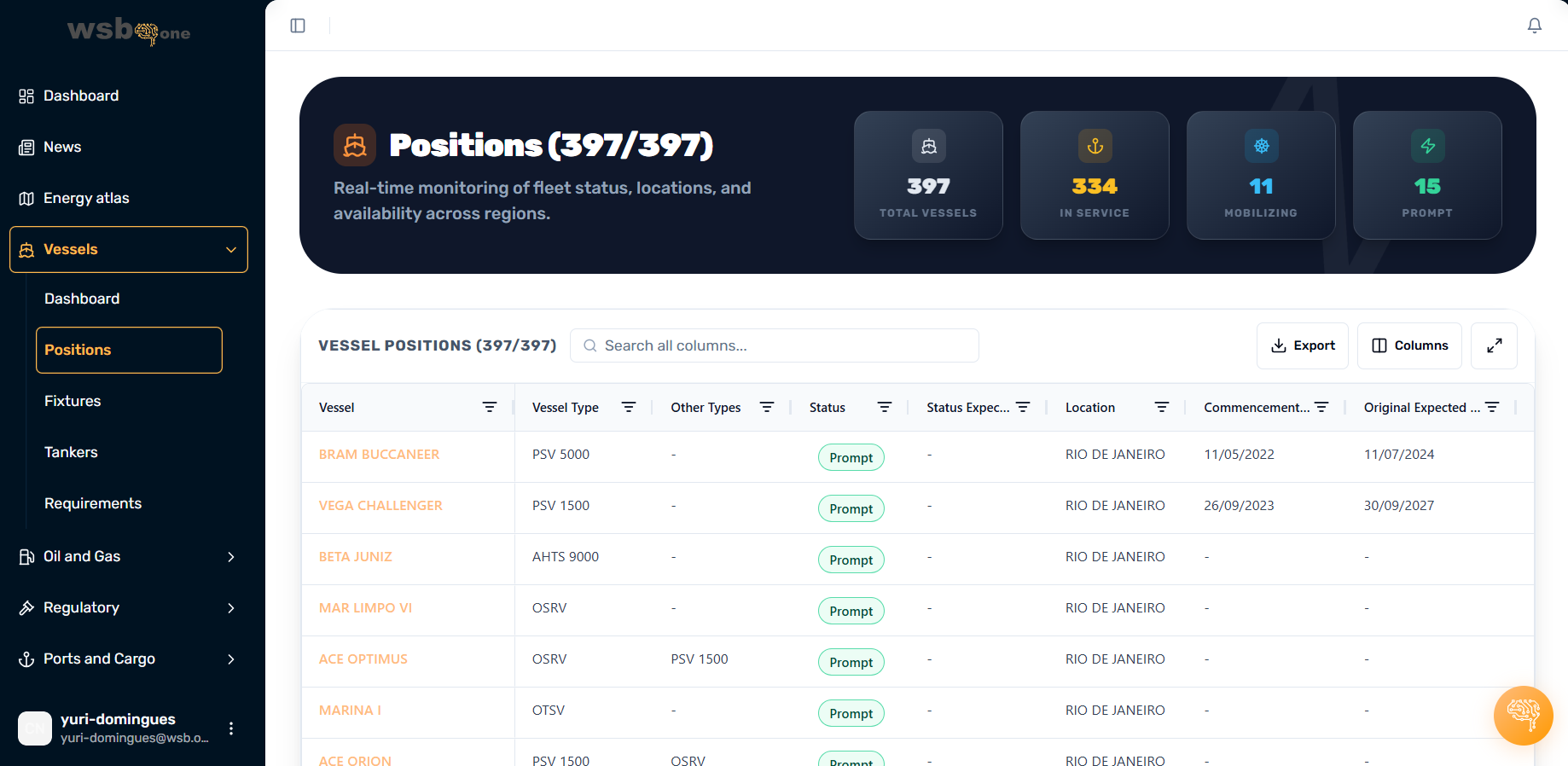
In the Fixture tab, users can search through spot and term fixtures realized in the Brazilian market since 2009. The platform displays daily rate information*¹, vessel name and type, charterer, scope of work, duration, start and expected end of each contract. It also provide users with filters, to enable specific and targeted searches for vessels, charterers, periods and scopes.
WSB-One Fixtures →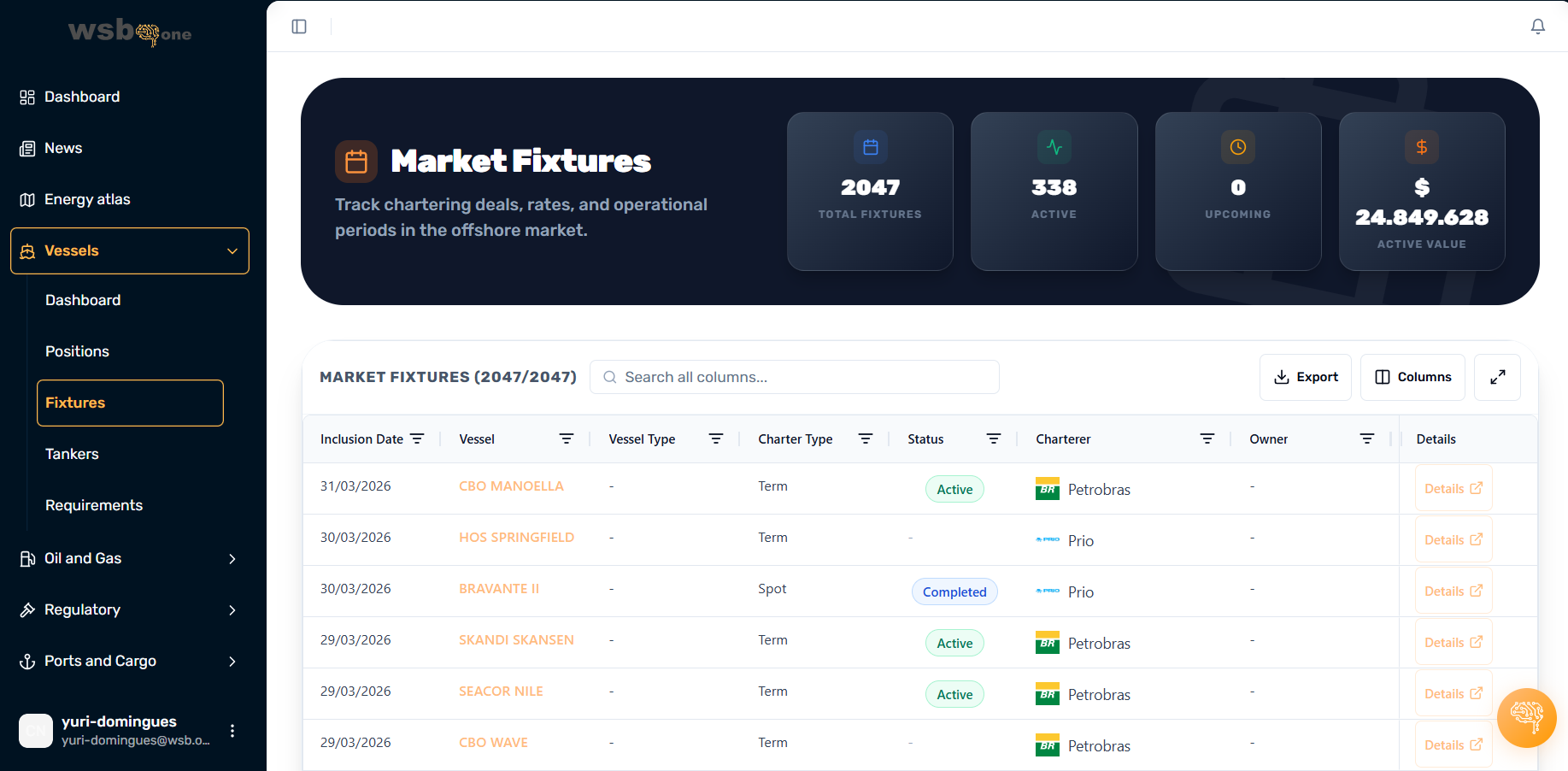
The Tonnage tab automatically pulls official data from ANTAQ and performs all the necessary tonnage calculations for each company. With this tool, you gain instant visibility into the total and available tonnage of all Brazilian Shipping Companies (EBNs) operating OSVs. It's a powerful resource to identify which competitors have the capacity to bring vessels into the REB, giving you a clear competitive edge.
WSB.One Tonnage →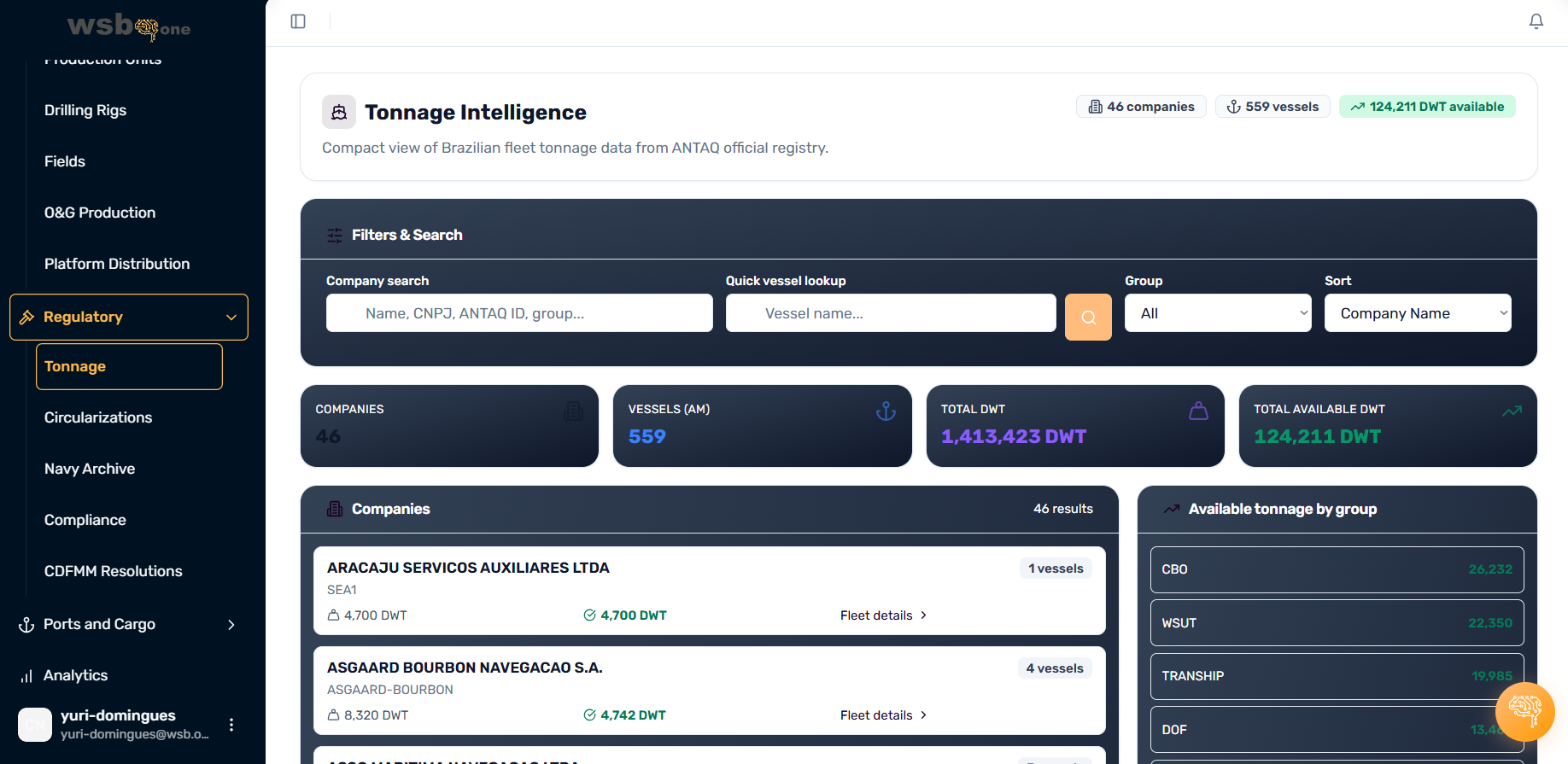
The system automatically generates several graphs based on the data displayed in every other tool of the platform, including but not limited to: Vessels Distribution by Status, Average Daily Rate by Vessel Type, Fleet Distribution by Flag, among others. All graphs are automatically updated as the system itself is fed with new information.
WSB-One Graphics →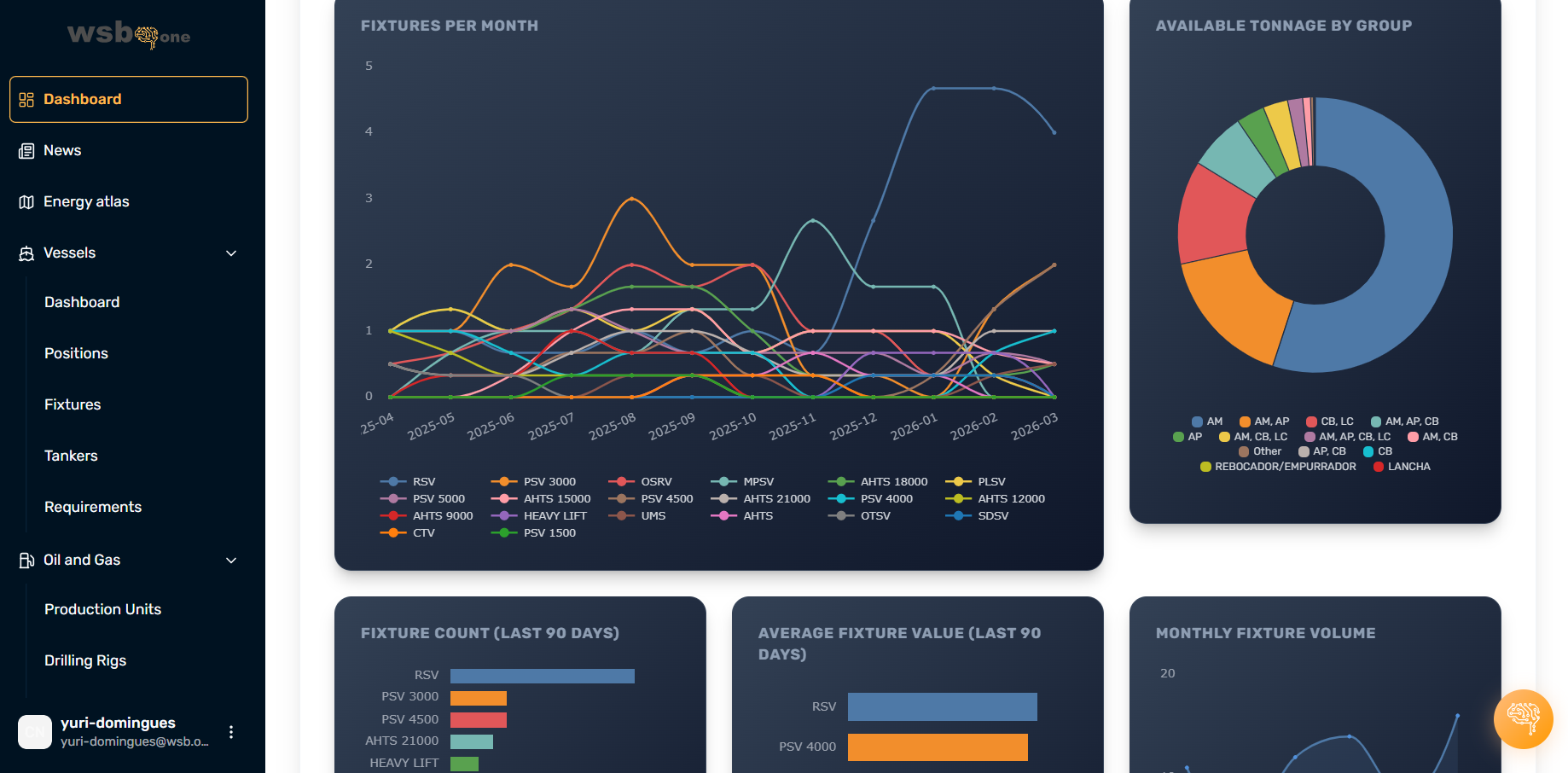
WSB provides specialized consulting across four expertise areas — Energy, Financial Services, Paralegal & Legal, and Environmental — delivering integrated solutions for the offshore sector.
"No loss should hit us which can be avoided with constant care."
— Mr. AP Møller
WSB is the leading offshore chartering broker in South America. Our offices are present in the United States and Paris, with a corresponding office in the United Kingdom.
WSB delivers the most accurate market information on offshore assets in Brazil with its own populated and dedicated database.
WSB solutions division supports customers' businesses within decommissioning, ship repair, shipbuilding and insurances.
WSB provides specialized consulting across four expertise areas — Energy, Financial Services, Paralegal & Legal, and Environmental.
Extensive experience in consulting across the energy sector. Our teams are ready to assist you in:
We lead you to the best strategy to make your business profitable and financially safe.
Consultancy so that our clients avoid legal issues.
We guide your company into a profitable business plan with no harm to the planet.
Start changing the future right now. Tell us about your project and our team will respond as soon as possible.
WSB establishes a separated market intelligence division to supply data services to charterers.
WSB deploys independent consulting teams with a first contract to assist in the largest FSRU project in country. WSB releases the beta version of WSB.One.
WSB joins the decommissioning segment with a winning bid on a Petrobras opportunity. WSB starts its advisory services for integrated logistics.
WSB enters the well stimulations market through an award for an exclusive partner. WSB delivers its first integrated gas-to-power study.
WSB enters the renewables energy segment as developer with Vento Leste Energia. WSB deploys the engineering services division.
WSB starts its commercial representation division. WSB delivers the structure for a new shipping company for port and dredging projects.
WSB Advisors secures the first decommissioning contract with an IOC in Brazil. WSB delivers an integrated engineering project for a dry-tow.
WSB Advisors carries out its first FPSO hook-up operation in Brazil. WSB Advisors secures a contract to support a shipyard in the preparation of the Technical and Commercial Proposal for the construction of 4x Handysize vessels.
WSB Advisors successfully leads the shipyard to win the award for the construction of 4x Handysize vessels and 5x gas carriers.
Industry-recognized professionals leading specialized teams across our expertise areas.
WSB keeps you up to date with latest news in the offshore market.
Browse and filter all articles.
Watch our latest content.
Start changing the future right now. Contact us directly or leave a message and we'll get back to you ASAP.
Av. Rio Branco, 12, 21st floor – CentroRio de Janeiro – RJ, 20090-000, Brazil
How WSB Advisors collects, uses and protects your personal information.
Last updated: 2025. This Privacy Policy describes how WSB Advisors ("we", "us") collects, uses and protects information when you use our website and services.
We may collect contact details you provide (name, email, company, phone) when you get in touch, subscribe to our newsletter or request information. We also collect usage data such as IP address and pages visited to improve our site.
We use your data to respond to enquiries, send relevant updates about our services and the offshore market, and improve our website and communications. We do not sell your personal data to third parties.
We apply appropriate technical and organisational measures to protect your data. We retain personal data only as long as necessary for the purposes described or as required by law.
You may request access, correction or deletion of your personal data by contacting us at comercial@wsb-advisors.com. You may also opt out of marketing communications at any time.
For privacy-related questions: comercial@wsb-advisors.com — Av. Rio Branco, 12, 21º andar, Centro, Rio de Janeiro – RJ, Brazil.
Terms and conditions for using the WSB Advisors website and services.
By accessing and using the WSB Advisors website you agree to these Terms of Use. If you do not agree, please do not use the site.
This website is for general information about WSB Advisors and the offshore energy sector. Content is subject to change without notice. You may not use the site for any unlawful purpose or in a way that could harm the site or our reputation.
All content on this site (text, images, logos, layout) is owned by WSB Advisors or its licensors and is protected by copyright. You may not reproduce, distribute or use it for commercial purposes without our prior written consent.
Information on this site is provided for general purposes only and does not constitute professional, legal or financial advice. Market data and reports are indicative; we do not guarantee their accuracy or completeness. For specific advice, please contact us directly.
To the fullest extent permitted by law, WSB Advisors shall not be liable for any indirect, incidental or consequential damages arising from your use of this website or reliance on its content.
These terms are governed by the laws of Brazil. Any disputes shall be subject to the courts of Rio de Janeiro.
Join a leading team in offshore advisory, broking and market intelligence.
WSB Advisors brings together recognized professionals in advisory, broking and intelligence for the offshore energy sector. We offer a dynamic environment where you can contribute to the largest proprietary database of offshore vessels, rigs and FPSOs in South America.
We are always interested in connecting with talented people. If you would like to explore opportunities with us, send your resume and a brief message and we will get back to you.
Send your CV to comercial@wsb-advisors.com with the subject line "Careers – [Your Name]" or use the form below.
WSB acts as 3rd party agent and partner for leading players in the offshore market.
WSB Advisors represents leading offshore companies as a 3rd party agent, deploying dedicated teams to develop new business and support clients across advisory, broking and engineering.
If you are interested in representation or partnership opportunities with WSB, we would be glad to discuss how we can work together.
Resources for journalists and media inquiries.
For press releases, interviews or media kit requests, please contact our communications team. We are happy to provide information about WSB Advisors, our services and the offshore market.